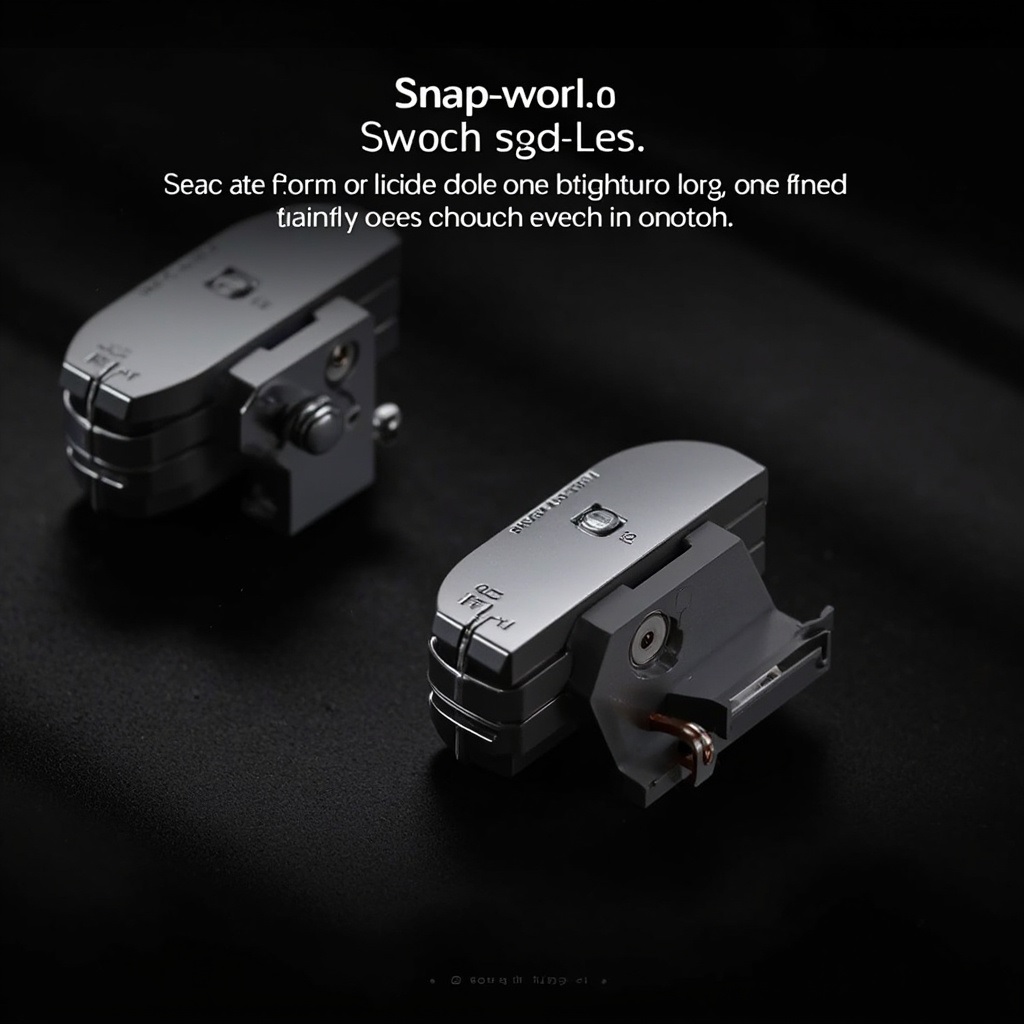
If you think a switch is just a switch, you haven’t been paying attention to the guts of your product. The difference between a snap action micro switch and a slow action switch isn’t a technical footnote—it’s the line between a device that responds instantly and one that drags its feet. Engineers often get caught up in voltage ratings and terminal styles, but the real decision comes down to one thing: how the contacts behave when you press that actuator.
Let’s cut through the noise. A snap action micro switch uses a spring-loaded mechanism that creates a sudden, crisp transfer of contacts. You push the plunger, and at a precise point, the internal spring flips the contacts with a satisfying click. This is the “snap” everyone talks about. It’s fast, it’s decisive, and it eliminates any chance of the contacts hovering in that dangerous middle zone where arcing and wear happen.
A slow action switch, on the other hand, is a different beast. The contacts move at the same speed as the actuator. Push it slowly, and the contacts creep together. Release it slowly, and they creep apart. There’s no snap, no sudden transfer. It sounds simple, but this design has consequences. The slower the actuator movement, the longer the contacts spend in partial contact, which can lead to pitting, oxidation, and inconsistent electrical performance over time.
So which one do you choose? It depends entirely on your application’s demands.
If your product needs precision, repeatability, and a clean break from electrical noise, snap action is the clear winner. Think about a thermostat in a heating system. You need that switch to open or close at a specific temperature point, not somewhere in a vague range. The snap action mechanism ensures that once the actuator reaches the trip point, the contacts change state immediately. No hesitation. No drift. That reliability is why Unionwell snap action micro switches are the go-to choice for industries like HVAC, automotive, and home appliances.
But slow action switches aren’t obsolete. They have a place where you want to control the speed of the contact transition. For example, in some audio equipment or signal routing, a slow, deliberate make-and-break can reduce the mechanical click noise that a snap action might introduce. There’s also a cost factor—slow action switches are often simpler to manufacture, which can lower the bill of materials for high-volume, low-criticality applications.
Here’s the catch: if you’re designing for safety or longevity, don’t gamble with slow action. In safety interlocks or limit switches on industrial machinery, you need that instant disconnect. A slow action switch can fail to break the circuit fast enough, leading to sparks or even equipment damage. The snap action mechanism is inherently safer because it forces a rapid separation of contacts, extinguishing any arc before it becomes a problem.
From a marketing perspective, this is where you sell the value. Don’t just list specs. Tell your customer that a Unionwell snap action micro switch gives their product a competitive edge—faster response, longer life, and fewer field failures. It’s a component that works behind the scenes but directly impacts user trust. Nobody wants a coffee maker that hesitates or a car door lock that sticks.
One more thing: don’t overlook the tactile feedback. Snap action switches give users a positive click, which is a subtle but powerful signal that the device has registered the input. That click is a form of communication. It says, “I heard you.” Slow action switches offer no such feedback, which can lead to user frustration in applications like push-button controls or handheld devices.
Bottom line: if your application demands speed, precision, and reliability, snap action is the only real option. If you’re building a low-stakes, budget-sensitive product where noise and feedback don’t matter, slow action might work. But in a world where customers expect everything to work perfectly every time, why take the risk? Choose the switch that snaps. Choose Unionwell.